

A Further Discussion on High-End Switches
Release Date:
2023-06-12
Source:
Author:
In control systems, it is often necessary to address a certain… at a specific moment. /Power distribution for multiple payloads. This requires adding a switch at the downstream end of the power busbar to accomplish it. There are two common switching modes, as shown in the figure below:
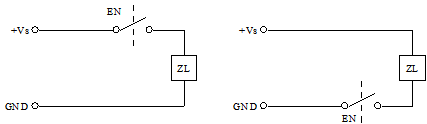
High-end switch Low-end switch
Both types are useful. High-end switches are primarily used for high… /Medium-voltage applications ; Low-end switches are primarily used for 5V/3.3V application scenarios. The following analysis focuses primarily on high‑end switches.
In principle, relays are the most convenient solution for high-end switching applications, and they exhibit very low contact resistance (typically on the order of a few…). milli- Oh, visual and tactile dot (Depending on the size of the area.) However, in modern electronic systems, relays are generally avoided whenever possible. The reason is that at the moment the relay is energized, /Instantaneous break (with a contact gap of um At the level of time) easy “Arcing” (especially in medium- and high-voltage applications) can adversely affect the service life of the system.
Therefore, in modern electronic systems, it is generally adopted that… MOSFETs, used as switching elements, are also referred to as “contactless switches.” Compared with relays, they have higher conduction losses (since the on‑state resistance of a MOSFET cannot be made extremely low), but their advantage is the absence of mechanical movement, resulting in a longer service life. Additionally, they can switch rapidly—crucial for certain types of loads. When using MOSFETs as high-side switches, there are two distinct scenarios:
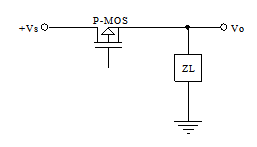
P-MOS: Easy to implement. However, due to The mobility of “holes” is low, so it is generally suitable only for medium voltage (10 V). ~ 100 V), and medium-power (≤10 A) applications.
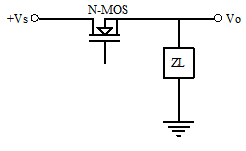
N-MOS: Need “Floating-gate” driving is difficult to implement. However, due to the high mobility of “electrons,” it is well suited for high-voltage applications (≥200 V) and high-power operations (≥ 5 0A) Application scenarios.
Both types of switches can be used to control the on/off state at will. /Close speed to adapt to different Zs L Load demand. In the figure, △V is the threshold voltage of the MOS transistor.
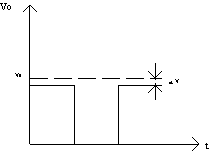
Fast switching: only conduction losses 。 Suitable for high-frequency applications 。
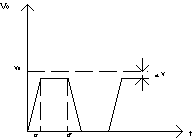
Slow switch: Except for In addition to static losses, there are also switching losses. , that is, the power loss caused by the charging and discharging of the MOS transistor’s gate‑source. 。 Suitable for applications where switching is infrequent. 。
Due to conduction losses and switching losses, in practical applications, one must consider the system’s control requirements and the load conditions. To The control strategy of the MOSFET has been adjusted, and To Add appropriate heat dissipation to the MOSFET.
So, what components should a fully functional high-end switch comprise? Below, taking… as an example, Let’s take a P‑MOS transistor as an example to illustrate this. (See the block diagram below.)
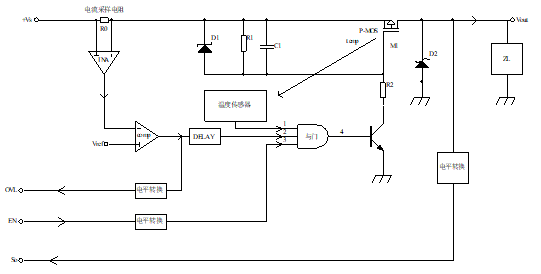
As can be seen from the block diagram above, a typical high-end medium-voltage, medium-power switch consists of switching devices ( M 1 ), current sampling ( R 0 ), high common-mode voltage instrumentation amplifier ( INA), comparator (COMP), delay 、 With logic gates 、 Level shifting and control enable /It consists of an RC network for current‑limiting, among other components. “OVL” indicates overcurrent, “S” O “EN” indicates “on” for the output. / Close control signals. This type of configuration is well-suited for aviation. 28V power supply system. Due to its simple architecture, compact size, and ease of implementation.
The following are several key points of this system that require special clarification:
- Power consumption 。 It mainly depends on M 1 The on-resistance R ON (under the assumption of negligible switching losses) and the current-sensing resistor R O The size. In general, it is selected as R ON and R O As small as possible.
- Switching rate control. By adjusting R 1、 R 2、 C 1 Completion depends on the characteristics of the load. If the load exhibits purely resistive behavior, it is well suited for fast switching control, thereby reducing… M 1 Dynamic power consumption. If the load is capacitive For inductive loads, only a slow-switching control strategy can be employed. This is because the voltage across a capacitor and the current through an inductor cannot change instantaneously. If the switching rate is too fast, it can easily trigger false overcurrent detections and may also introduce disturbances into the power supply system.
- Overcurrent hiccup mode ( hiccup), by adjusting the comparison output delay and controlling M 1 The rise of /Down‑time is jointly achieved. The hiccup mode is a function that all power supply systems should support, exhibiting the characteristics shown in the figure below.
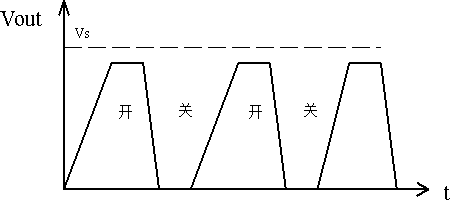
That is to say, upon the departure of the upper-bound aircraft. When the EN signal is active, the high-side switch should be in its normal powered‑on state. However, due to the load Z… L When an overload occurs (such as a short circuit), the current-sensing resistor… R 0 This overcurrent is detected, and local control is subsequently activated. M 1 Deadline. M 1 After the cutoff, the overcurrent condition disappears, and normal power supply resumes. However, since the overcurrent state persists, the system attempts to shut down again. M 1 . In this way, the cycle repeats continuously, producing a waveform similar to that shown in the figure above, commonly referred to as “Hiccup state.”
Its importance is reflected in two aspects: first, by locally and intermittently turning the switching transistor on and off. M 1 First, to protect the tube from burning out. Second, the host computer monitors the overcurrent indication signal. After “OVL” hiccups a specified number of times, issue an EN command to remotely shut down M. 1。
- Level translation is primarily intended to match the signal levels of the host central control computer. Flat Designed for compatibility. Sometimes, due to the central control computer and… +V S If the power supply system is not grounded, isolation must also be implemented.
- D 1 Its function is to protect. M 1 The gate-source does not break down. D 2 The function is to M 1 It provides load freewheeling when disconnected.
The foregoing discusses the implementation approaches for high-end medium-voltage, medium-power switches.
Below is a brief overview of the implementation strategy for a high-voltage, high-power, high-end switch.
The primary consideration in the design of high-voltage, high-power, high-end switches is to minimize power consumption. Therefore, the aforementioned… “ Shunt “Type current sampling can no longer be used. In addition, due to…” Due to mobility issues and manufacturing process factors, it is very difficult to achieve... ≥ Withstand voltage exceeding 200 V and low on-state resistance. R o n , Must be replaced with It is implemented using N‑MOS transistors. Furthermore, considering that crosstalk on the power ground (PGND) could interfere with or even damage the upper-level central control computer, the OVL, EN, and SO signals must be isolated. Lastly, heat dissipation is a concern; in some cases, air cooling is no longer sufficient, necessitating oil‑cooling or water‑cooling. M 1 Heat dissipation. (See the diagram below)
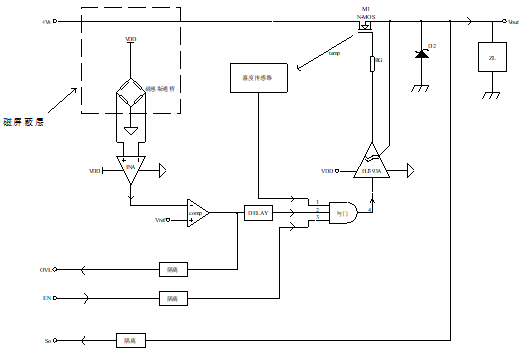
As can be seen from the figure above, adopting The N‑MOSFET is used as a switching element; a magnetic Wheatstone bridge is employed for current sensing, and the HJ393A driver is utilized to drive the N‑MOSFET. A temperature sensor is incorporated to measure the N‑MOSFET’s junction temperature, and a control supply voltage V must be introduced. DD Such a combination helps reduce power consumption (without the aforementioned…). R O ), able to complete The floating-gate drive of an N-MOS device can also implement over-temperature protection.
As a sophisticated high-end switch design, in addition to considering its basic components, , Also need to consider Load (that is, In the above figure, ZL ) characteristics of 。 Purely resistive loads do not exist. , Typical loads are resistive. R, Capacitor C, Inductance L A composite system. The energy-storage effect of the capacitor can cause switching. pipe M 1 Guide Transient current surge Surge , of the inductor Continuation Flow effects can cause M 1 It must withstand during turn-off. Negative Voltage pulse , All these factors will affect the power transistor. M 1 It has a negative impact on long-term reliable operation.
Finally , As a high-end switch designed for use in harsh environments. Should also Consider environmental stress. ( For example, temperature. Stress, Impact / Vibrational stress 、 Electromagnetic environmental stress etc.)’s Adaptability.
Keywords:
Hot News
Leave a Message Online
*Note: Please ensure that all information provided is accurate and keep your contact details up to date. We will get in touch with you as soon as possible.
Request for Samples / Product Manuals / Contact Information:
Mr. Jia:13022932841(WeChat)
Landline:029-89259995Transfer 833
Technical Support / Contact Information:
Mr. Zhao:13572473285
Landline:029-89259995Transfer to 803
Ms. Xu:18729396827
Company landline:029-89259995
Fax: 029-89259996
Unit 4, Building 6, Beihang Science and Technology Park, Hangtian Middle Road, Aerospace Base, Chang’an District, Xi’an, Shaanxi Province
