
A domestically produced LVDT/RVDT conditioner that replaces AD698
Release time:
2024-04-01
HJG698 is an LVDT/RVDT excitation demodulator designed using thick film integrated process
Function replaces the domestically produced LVDT/RVDT conditioner AD698.
I. Background
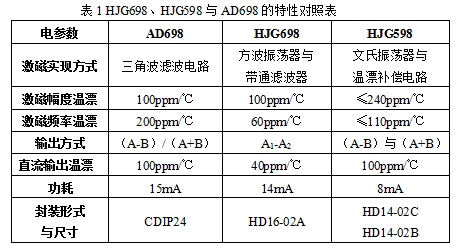
With the continuous demand and development in aerospace, shipping, industrial control, and agricultural modernization across various countries, the demand and application requirements for displacement sensors are also on the rise. Moreover, the structural requirements for displacement sensors vary across different application fields. Hangjing early launched a domestically produced displacement sensor excitation demodulation circuit HJG598 to replace AD598, which has been successfully used in various assembly applications and is compatible with both five-wire and six-wire displacement sensors. Now, to fill the gap in applications for half-bridge three-wire and four-wire displacement sensors, Hangjing has combined its extensive experience in analog circuit design and application to introduce a brand new domestically produced displacement sensor excitation demodulation circuit HJG698, which can completely replace the imported device AD698.
II. Overview
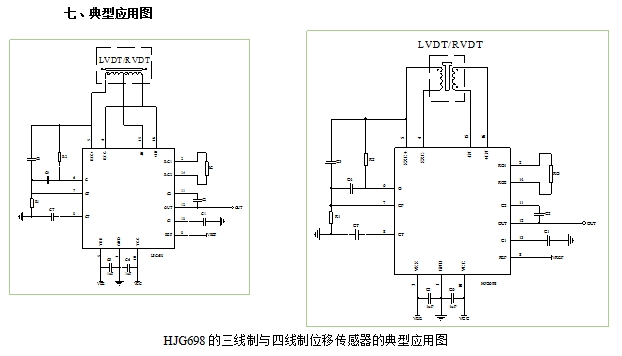
HJG698 is an LVDT/RVDT excitation demodulator designed using thick film integrated technology that meets GJB2438 internal control indication requirements. It includes a square wave oscillator, a band-pass filter, and an operational amplifier with differential output functionality to generate excitation signals that drive the primary side of LVDT/RVDT. At the same time, HJG698 performs differential calculations on the amplitude-modulated wave signals output from LVDT/RVDT and converts them into DC voltage signals for output.
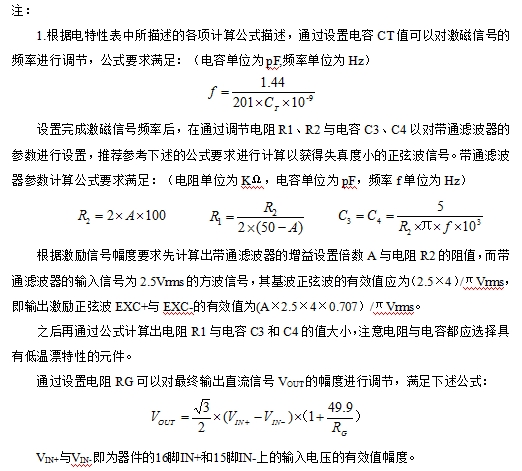
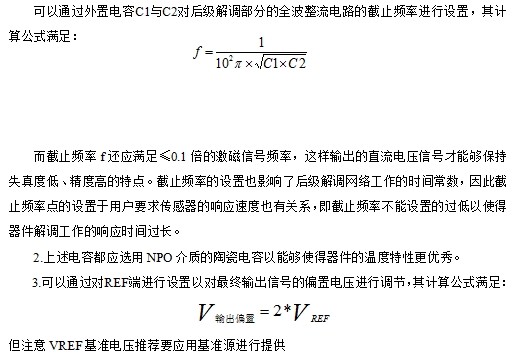
The excitation of HJG698 combines a square wave oscillator with a band-pass filter to filter the square wave signal into a sine wave signal. It uses a low-drift precision voltage source to power the oscillation circuit network; thus, by selecting low-temperature coefficient types for peripheral resistors and capacitors of the device's band-pass filter network, low-temperature drift sine wave signal excitation output can be achieved. A differential output amplifier with a gain of 1/1 is used as an excitation signal output to drive LVDT/RVDT so that even if there is no common ground port for LVDT/RVDT, HJG698 can still operate normally and can drive three-wire half-bridge or four-wire sensors. The subsequent demodulation part adopts a differential input structure which suppresses temperature drift of the differential excitation signal at the working principle level of the subsequent demodulation circuit, resulting in lower temperature drift of the output DC signal. It is very suitable for precision positioning and measurement applications with advantages such as low temperature drift, high detection accuracy, high reliability, and high sensitivity. It can be applied in angle position detection systems in servo control systems, aerospace, electronics, etc.
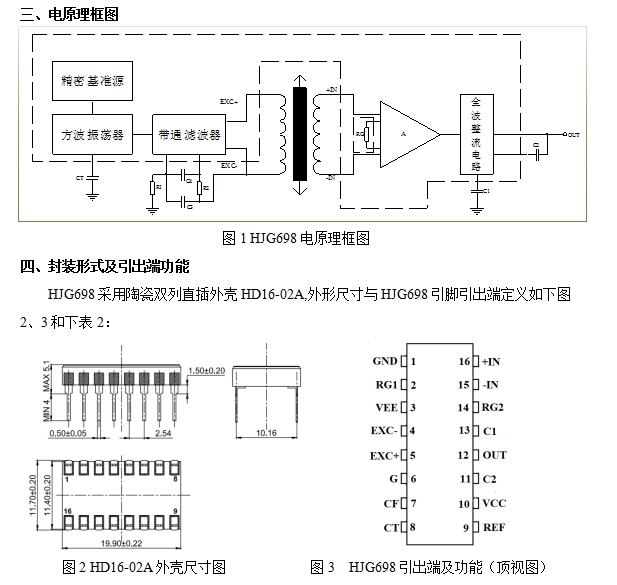
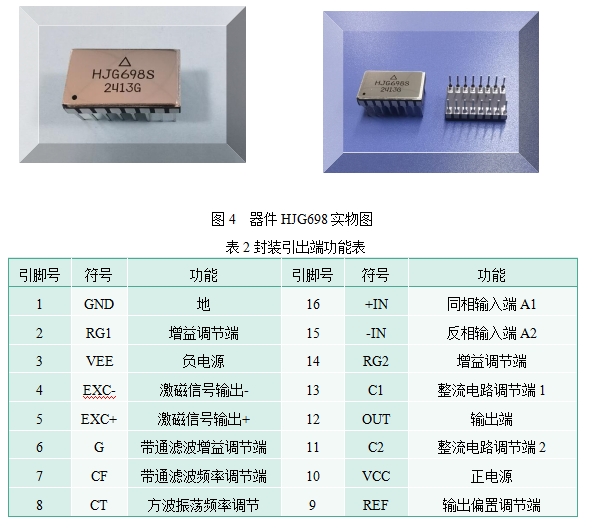
V. Absolute Maximum Ratings
Power Supply Voltage ±18V
Dissipated Power 1000mW
Operating Temperature -55℃~125℃
Storage Temperature -65℃~150℃
Lead Soldering Temperature (10s) +300℃
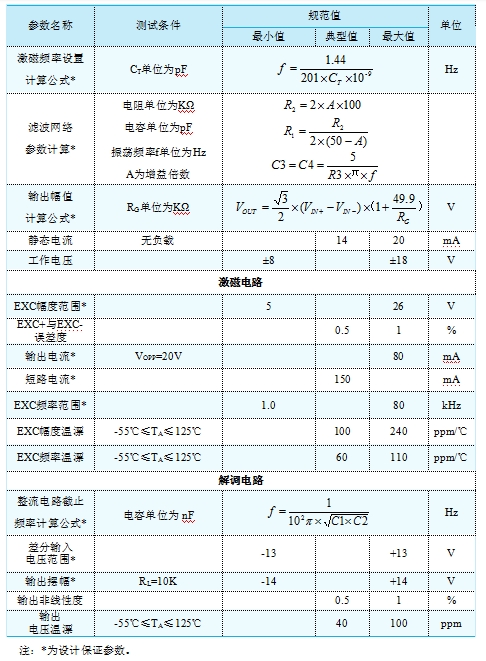
VI. Electrical Characteristics
Unless otherwise specified,CC=+15V,VEE=-15V,TA=25℃
Key words:
Integration,Demodulator
recommend News
Exploring Operational Amplifiers: A Cornerstone of Advanced Electronic Signal Processing
Exploring Operational Amplifiers: A Cornerstone of Advanced Electronic Signal Processing Table of Contents What Are Operational Amplifiers? History and Evolution of Operational Amplifiers How Do Operational Amplifiers Work? Key Features and Specifications of Operational Amplifiers Applications of Operational Amplifiers in Electronics Advantages of Using Operational Amplifi
2026-06-23
Enhancing Data Acquisition with High-Speed Amplifiers
High-speed amplifiers play a crucial role in the domain of data acquisition, especially when precision and speed are paramount. These devices are designed to amplify low-level analog signals while preserving their integrity, which is essential for accurate data interpretation. In this article, we will delve into the significance of high-speed amplifiers in data acquisition, their functionality, an
2026-06-22
Choosing the Right Wideband Amplifier for Your Communication Needs
Choosing the Right Wideband Amplifier for Your Communication Needs Table of Contents 1. Introduction to Wideband Amplifiers 2. Understanding Wideband Amplifiers 2.1 Definition and Importance 2.2 How Wideband Amplifiers Work 3. Key Specifications to Consider 3.1 Frequency Range 3.2 Gain 3.3 Noise Figure 3.4 Input and Output Impedance
2026-06-21
Understanding Power Amplifiers for Motor Control Applications
Power amplifiers play a vital role in motor control by delivering the necessary power to drive motors effectively. These devices amplify low-power control signals into higher power levels that can be used to control the speed and torque of motors in various applications, from industrial machines to consumer electronics. Understanding how power amplifiers work and their integration into motor contr
2026-06-20
Innovative Use Cases of Rail-to-Rail Amplifiers in Electronic Design
Innovative Use Cases of Rail-to-Rail Amplifiers in Electronic Design Table of Contents 1. Introduction to Rail-to-Rail Amplifiers 2. What is a Rail-to-Rail Amplifier? 3. Working Principle of Rail-to-Rail Amplifiers 4. Key Benefits of Using Rail-to-Rail Amplifiers 5. Innovative Applications of Rail-to-Rail Amplifiers 5.1. Enhancing Audio Quality in Consumer Electronics 5
2026-06-19