
HJMAG803A high-temperature three-axis high-precision weak magnetic measurement module mounted on the satellite
Release time:
2023-06-12
two small satellites made in Shenzhen—the commercial meteorological detection constellation experimental satellite
On October 14, 2021, at 18:51, two small satellites made in Shenzhen—the commercial meteorological detection constellation experimental satellite and the orbital atmospheric density detection experimental satellite—were successfully launched by the Long March 2D rocket from the Taiyuan Satellite Launch Center. Based on thorough testing and evaluation in the early stages, the company carried our HJMAG803A high-temperature three-axis weak magnetic measurement module. This not only deepens the confidence of further cooperation between the two units but also demonstrates that the years of hard work by Hangjing people have been tested in practical applications. We will continue to uphold the spirit of craftsmanship, persistently improve product quality consistency and reliability, achieve our ideal of serving the country through microelectronics with high-performance products and services, and continuously exceed customer expectations.
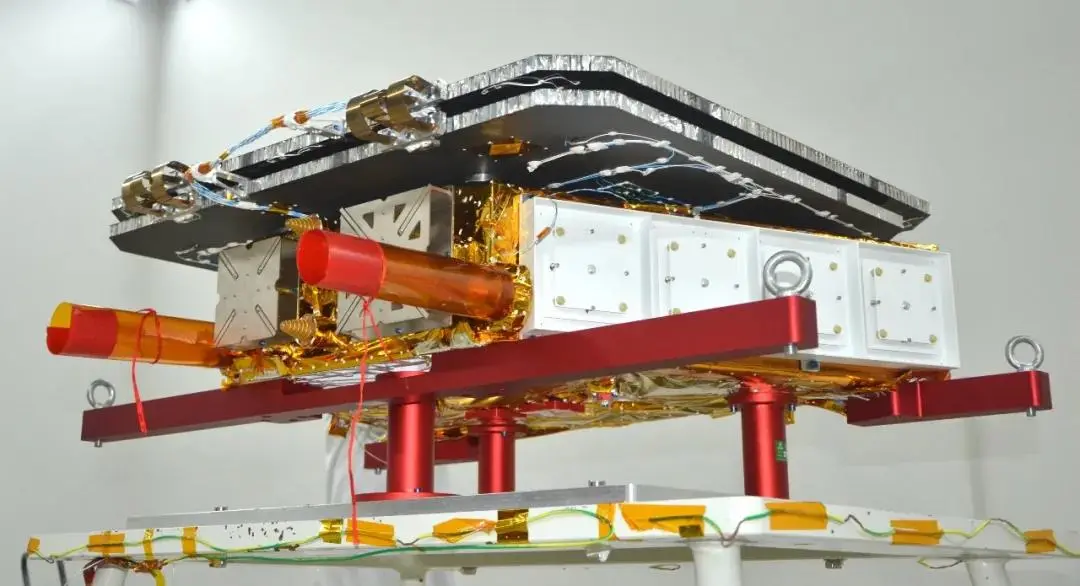
Figure 1 Satellite physical diagram

FigureFigure 2 On-site assembly diagram
HJMAG803A is a high-temperature three-axis high-precision weak magnetic measurement module. The circuit consists of an oscillation source, acceleration network, driving network, voltage doubling network, amplification network, synchronous demodulation network, integration network, feedback network, bias circuit, and temperature measurement circuit. It uses a magnetoresistive sensor circuit method to measure the geomagnetic field of the surrounding environment, achieving mutual conversion between geomagnetic signals and voltage signals. The module can operate at temperatures up to 175°C.

FigureFigure 3 Principle block diagram

FigureFigure 4 Product physical object
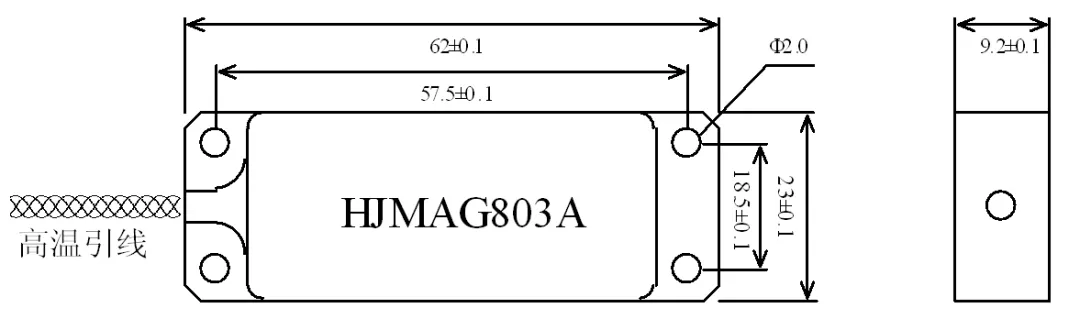
FigureFigure 5 Module packaging form
This weak magnetic measurement module is mainly used to measure the angle between the satellite and Earth's magnetic field ((Ox, Oy, Oz), providing a basis for adjusting satellite attitude. Compared to traditional fluxgate sensors, it has advantages such as low energy consumption, high reliability, good stability, and small size; simulating PID loop applications results in minimal secondary nonlinearity and drift over time. This series of weak magnetic measurement modules is widely used in fields such as Measurement While Drilling (MWD), gamma measurements, pitch angle measurements, navigation attitude determination, and non-reference rotational speed measurements. Several independently developed high-precision weak magnetic measurement modules have served various fields including oil exploration and satellites. The series includes: HJMAG803, HJMAG804, HJMAG805A.
Key words:
commercial,constellation
Previous Page
Next Page
Previous Page:
Next page:
recommend News
Exploring the Advantages of Low Voltage Rail-to-Rail Operational Amplifiers: A Comprehensive Guide
Exploring the Advantages of Low Voltage Rail-to-Rail Operational Amplifiers In the fast-evolving field of electronics, the quest for devices that offer efficiency, precision, and versatility is unending. One such innovation that has made significant strides in this domain is the low voltage rail-to-rail operational amplifier (op-amp). These amplifiers have become increasingly popular due to their
2026-03-23
Understanding Precision Amplifiers for Data Acquisition Systems
Precision amplifiers play a critical role in data acquisition systems, which are essential for gathering and analyzing measurement data in various applications. These amplifiers are designed to enhance the accuracy and reliability of signals coming from different sensors and transducers, making them invaluable in fields such as industrial automation, medical devices, and environmental monitoring.
2026-03-22
Understanding the Role of Instrumentation Amplifiers in Bridge Sensor Applications
Understanding the Role of Instrumentation Amplifiers in Bridge Sensor Applications Table of Contents 1. Introduction to Instrumentation Amplifiers and Bridge Sensors 2. What Are Instrumentation Amplifiers? 3. Basics of Bridge Sensors: Types and Applications 4. Why Are Instrumentation Amplifiers Essential in Bridge Sensor Applications? 5. Key Design Principles of Instrumentation Amplifiers 6. Appl
2026-03-21
Optimizing Measurement Systems with Operational Amplifiers
Operational amplifiers (op-amps) are fundamental components in measurement systems, serving as versatile tools in various electronic applications. Their ability to amplify weak signals makes them indispensable in environments where precision is paramount. In this article, we will delve into the functionality of operational amplifiers, their applications in measurement systems, and the advantages t
2026-03-20
Unlocking the Potential: How Operational Amplifiers Enhance Analog Signal Conditioning
Unlocking the Potential: How Operational Amplifiers Enhance Analog Signal Conditioning Table of Contents 1. Understanding Operational Amplifiers 2. The Role of Analog Signal Conditioning 3. Key Features of Operational Amplifiers 3.1. High Input Impedance 3.2. Low Output Impedance 3.3. High Voltage Gain 4. Common Applications of Operational Amplifiers in Signal Conditioning 4.1. F
2026-03-19