

Various Applications of Differential Amplifiers
Release Date:
2023-10-30
Source:
Technical Department/Marketing Department
Author:
Hangjing Microelectronics
Various Applications of Differential Amplifiers
I. Overview
Currently, the market offers a wide variety of operational amplifiers, including general‑purpose types, precision op-amps, high‑input‑impedance models, high‑speed devices, low‑power variants, and high‑voltage, high‑power solutions—each with its own distinctive characteristics. When selecting components, engineers should choose the appropriate type based on the specific application requirements. Among these, differential op-amps are frequently employed in signal acquisition and transmission due to their high accuracy and strong noise‑rejection capabilities.
II. Application Areas
1. In applications where the input voltage range is lower than the supply voltage.
Undergoing stress / Magnetism / When implementing signal acquisition and processing at both ends of a temperature Wheatstone bridge, given that its input voltage range is lower than the supply voltage, an instrumentation amplifier can be employed for signal conditioning and processing.
Instrumentation amplifiers are highly favored for applications involving the acquisition of weak signals and the amplification of sensor outputs, thanks to their high common-mode rejection ratio, high input impedance, low noise, low linearity error, low offset drift, and adjustable gain. Hangjing Company has currently completed the development of an instrumentation amplifier. HJG620、HJG826、HJG118、HJG128、HJG333 and HJ52301 The research and design of this series of devices have already been widely adopted and can serve as a substitute for imported components. AD620、INA826、INA118、INA128、INA333 and MII-52301 The components have undergone complete domestic substitution.
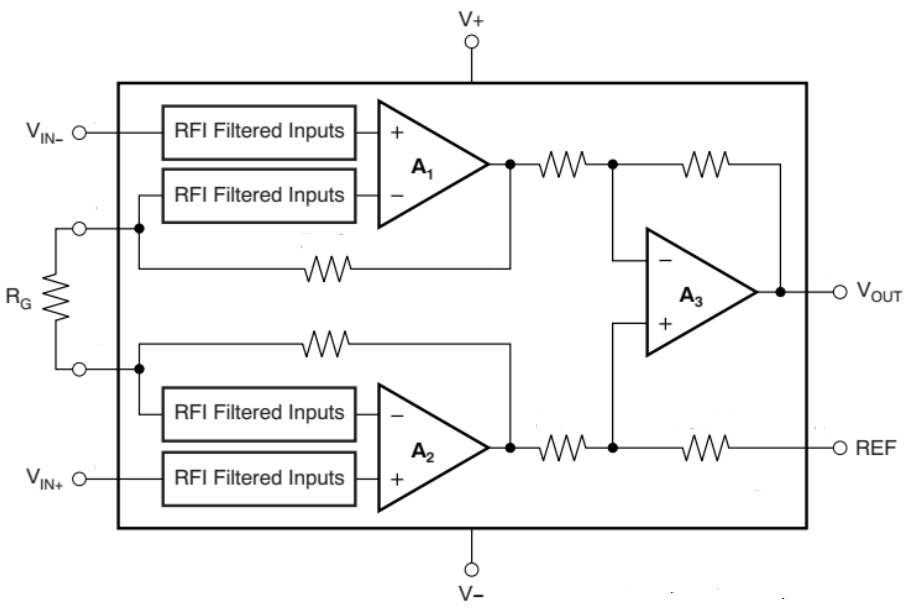
Figure 1 Typical block diagram of an instrumentation amplifier
However, when applying instrumentation amplifiers, it is essential to consider the device’s operating environment. Unsuitable operating conditions can degrade the device’s performance parameters, leading to increased output errors.
Applications of Instrumentation Amplifiers REF The input terminal can be used to adjust the bias of the output signal, but please note that… REF The input signal at the terminal must have a low output impedance and the ability to both sink and source current, thereby ensuring that the device’s output error remains within acceptable limits. In other words, an operational amplifier is used to provide a buffered input. REF Using a reference voltage source at the terminal or in the application REF The terminal voltage setting can ensure a small output error, while employing a resistive voltage divider or… LDO This approach will increase the device’s output error and reduce acquisition accuracy.
The operating range of an instrumentation amplifier depends on the common-mode voltage, the gain, and… REF The input common-mode voltage—i.e., the magnitude of the input common mode—exerts a significant influence on the device’s operating characteristics; this relationship is known as the diamond plot of an instrumentation amplifier. This common-mode‑dependent behavior warrants particular attention when the instrumentation amplifier is employed in single-supply applications.
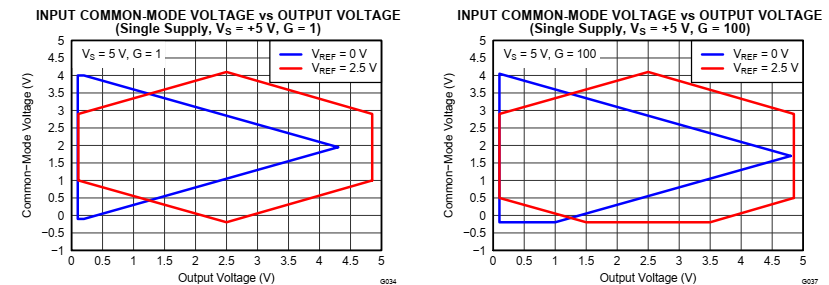
Figure 2 Typical diamond plot of an instrumentation amplifier operating from a single supply
As shown in the figure above, when an instrumentation amplifier powered by a single supply is configured for a large output swing, its input common-mode voltage range becomes very narrow—at typical supply voltages. In such cases, if one wishes to acquire small‑amplitude voltage signals at the input, it is necessary to… REF Applying a new bias voltage at the input can correspondingly widen the input common-mode voltage range.
2. Input voltage range greater than the supply voltage in a common-ground system ( common GND )
When the input voltage exceeds the supply voltage, the aforementioned instrumentation amplifier can no longer be used for signal acquisition and processing; instead, a differential amplifier must be selected.
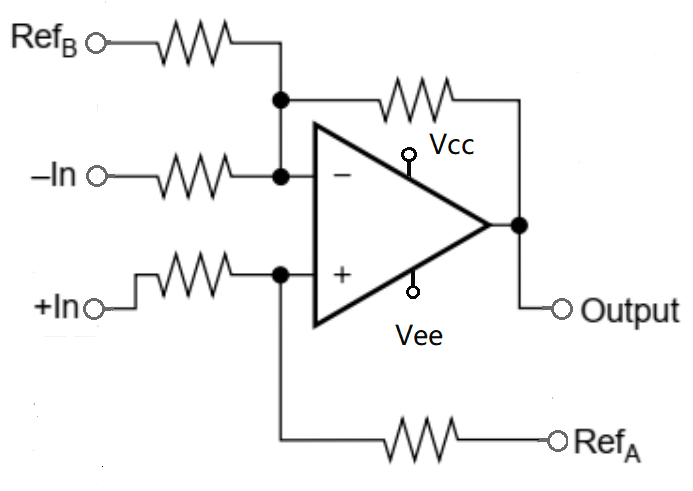
Figure 3 Typical block diagram of a differential amplifier
A differential amplifier first scales the input voltage by a fixed ratio and then reconfigures its internal gain network to achieve a stable overall gain. This circuit topology enables the device’s input voltage range to be amplified beyond the supply‑rail limits. For the external resistors, low‑temperature‑coefficient thin‑film materials are employed to ensure excellent thermal stability, minimizing the impact of temperature variations on output error and maintaining high‑precision acquisition and processing of input signals. Moreover, the differential amplifier’s relatively high input impedance makes it less susceptible to white noise and input ripple, allowing it to replace isolated amplifiers without requiring additional filtering or isolation stages—thus significantly reducing system cost.
Hangjing Company has currently completed HJ133A、HJINA148 and HJ629 The research and design of a differential amplifier can match imported models. INA133、INA148 and AD629 The differential amplifier has been fully localized and replaced with a domestically produced alternative. Moreover, this product category has already garnered substantial procurement orders and extensive field deployment by customers.
3. Input voltage range greater than the supply voltage in a non-grounded system ( galvanic isolation )
Due to the lack of a common ground, the signal under test is often embedded in complex common-mode and differential-mode interference, accompanied by common-mode transient disturbances.
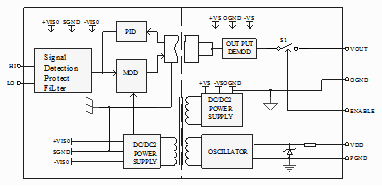
Figure 4 Typical Functional Block Diagram of an Isolation Amplifier
An isolation amplifier is a specialized measurement‑amplification circuit in which the input, output, and power supply circuits are electrically isolated from one another—meaning that the signal path has no common ground. The device provides electrical isolation between its input and output, and it is an integrated circuit capable of conditioning, isolating, amplifying, and transmitting various types of information signals. It can effectively isolate and amplify weak input signals even under harsh electromagnetic conditions.
Due to their internally isolated design, isolation amplifiers generally exhibit strong common-mode transient rejection. When the input signal experiences sudden, large voltage changes, their exceptionally high common-mode transient suppression ensures that these variations do not propagate to the device’s output—meaning that even if the input is subjected to destructive voltage spikes, the device’s performance remains unaffected. Moreover, by operating in a power‑isolated mode, isolation amplifiers can eliminate measurement errors caused by ground loops, thereby enhancing measurement accuracy. In short, isolation amplifiers offer superior precision in acquiring and amplifying weak signals.
Hangjing Company has currently completed HJ278 and HJ5B40 The research and design of a series of isolation amplifiers can match imported models. ADI-5B40 The isolation amplifier has been fully replaced with a domestically produced alternative. Among them, HJ5B40 The isolation withstand voltage between series inputs and outputs can reach 4242V This product category has already been widely purchased and extensively applied by customers.
Keywords:
Previous page
Hot News
Leave a Message Online
*Note: Please ensure that all information provided is accurate and keep your contact details up to date. We will get in touch with you as soon as possible.
Request for Samples / Product Manuals / Contact Information:
Mr. Jia:13022932841(WeChat)
Landline:029-89259995Transfer 833
Technical Support / Contact Information:
Mr. Zhao:13572473285
Landline:029-89259995Transfer to 803
Ms. Xu:18729396827
Company landline:029-89259995
Fax: 029-89259996
Unit 4, Building 6, Beihang Science and Technology Park, Hangtian Middle Road, Aerospace Base, Chang’an District, Xi’an, Shaanxi Province
