
HJ5B40 isolation amplifier
Release time:
2021-10-29
In modern electronic measurement, engineers often need to reliably and accurately collect a specific physical quantity
Hangjing Microelectronics has successfully developed an isolation amplifier that outperforms the imported 5B40.
In modern electronic measurement, engineers often need to reliably and accurately collect a physical quantity, such as current or voltage and their variations, from an extremely complex electromagnetic environment (for example, the magnetic field generated by cables carrying large currents). The measured physical quantities are usually very small and often accompanied by significant interference. For instance, high common-mode voltage (CMV), strong electromagnetic interference (EMI), and fast transient disturbances (dV/dt or dI/dt). If these interference issues are not effectively addressed, the accuracy of the collected physical quantities will decrease, potentially posing significant risks to system reliability and safety.
The following interference analysis diagram can be used to describe:
Interference Analysis Diagram

To solve the above problems, engineers appropriately choose isolation amplifier conditioning circuits. This circuit must have good electromagnetic compatibility (EMC) performance, resistance to high common-mode voltage (CMV) breakdown performance, and common-mode transient immunity (CMTI) performance; otherwise, it is an incomplete solution.
EMC: The ability of a device or system to operate as required in its electromagnetic environment without causing intolerable electromagnetic interference to any equipment in that environment. It includes two parts: electromagnetic interference (EMI) (the disturbance caused by electronic components to the outside world) and electromagnetic susceptibility (EMS) (the interaction between electromagnetic waves and electronic components).
CMV: The average value of the phasor voltage that appears between each conductor and the specified reference point.
CMTI: The minimum rise or fall dV/dt required for a transient to cross the isolation barrier and disrupt the driver output state.
The design concepts and components of isolation amplifier conditioning circuits vary. Each of the three elements is treated with different emphases, which limits product adaptability. Hangjing Microelectronics has fully recognized the application background of isolation amplifiers. By referencing mature design concepts from abroad and relying on team engineering experience in power conversion, modulation-demodulation, analog PID control, etc., they have further integrated microelectronic isolation technology. They successfully developed an isolation amplifier module HJ5B40 that mimics the imported 5B40. Its pin configuration is fully compatible with similar foreign products; its size is half that of similar foreign products; its isolation withstand voltage is 3800V, higher than similar foreign products; CMTI parameters also outperform those of similar foreign products.
HJ5B40 Isolation Amplifier
1. Overview
The HJ5B40 Isolation Amplifier is a special-purpose operational amplifier that isolates power supply circuits, input circuits, and output circuits by breaking ground loops. This product is designed to isolate and amplify weak signals in complex electromagnetic environments while reliably converting signals from -100mV to +100mV into -5V to +5V outputs under high fidelity conditions. The loop gain is set internally at 50 times using precision resistors (loop gain can be customized according to customer requirements). Related products can also be developed based on customer needs.
Features:
1. Electrically isolates weak signals being measured
2. Single digital +5V power supply
3. Three-ground system: Power ground PGND, signal ground SGND, output ground OGND
4. Strong common-mode transient suppression capability (CMTI ≥50kV/μs)
5. Isolation voltage (CMV ≥3800V)
6. Surge absorption, protection, and filtering functions
7. Measurement bandwidth of up to 10kHz
8. Small size and lightweight
9. Optional through output

2、 (2) Principle of Isolation Amplifier
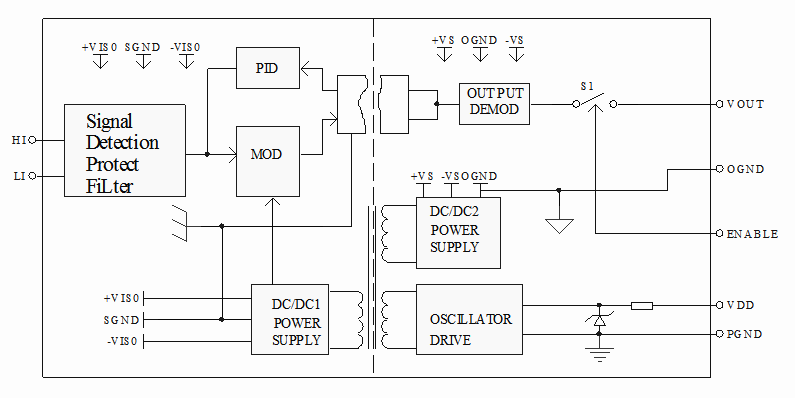
(The HJ5B40 Isolation Amplifier provides an analog input channel that is amplified, isolated, and converted into a high-level analog voltage output controlled by logic switches.) This allows modules to share one analog bus without needing external multiplexers for operation if needed for output; simply connect the enable terminal to power ground for operation.
Electrical Schematic Diagram
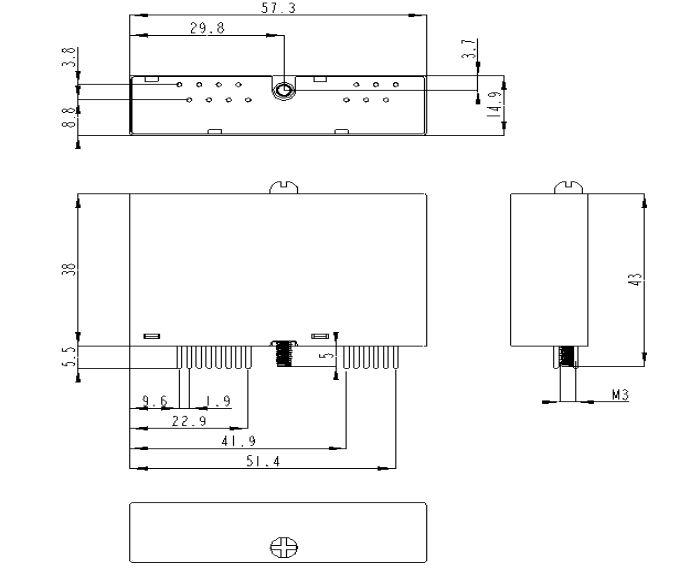
(3) Package Form and Pin Functionality
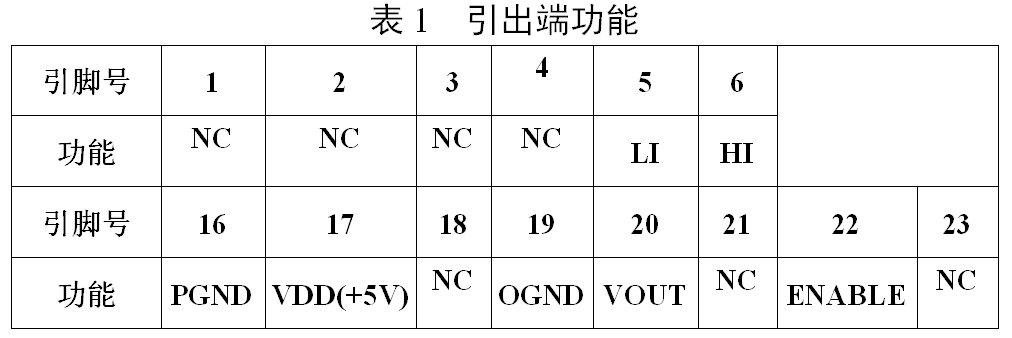
Pin functionality is shown in Table I below
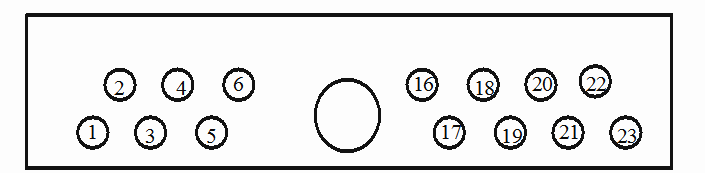
(4) Related Applications
The HJ5B40 is suitable for placement away from measured targets but if the on-site electromagnetic environment is harsh it is recommended that customers use shielded twisted pairs for connection with external shielding connected to PGND.
If HJ5B40 is placed far from the acquisition board in order to ensure signal-to-noise ratio it’s recommended users utilize standard current transmission loops of about four~twenty mA at remote ends completing I/V conversion.
Related Products
HJ278 Three-Channel Isolation Amplifier
HJU126B Current Loop Transmitter
HJU0420 Three-Wire High-Temperature Precision Current Loop Transmitter
Key words:
5B40, isolation amplifier, loop gain
recommend News
Future-Proof Your Communication Systems with Wideband Amplifiers
Future-Proof Your Communication Systems with Wideband Amplifiers Table of Contents Understanding Wideband Amplifiers: A Comprehensive Overview The Importance of Wideband Amplifiers in Communication Systems Key Benefits of Using Wideband Amplifiers Applications of Wideband Amplifiers in Various Industries How to Select the Right Wideband Amplifier for Your Needs Future Trends in Wideba
2026-10-06
Understanding Power Amplifiers for Motor Control: Essential Insights for Electronics Enthusiasts
Power amplifiers for motor control are pivotal components that enhance the efficiency and performance of electric motors. They take low-power control signals and amplify them to a level sufficient to drive a motor effectively. This amplification is essential for applications that require precise control over motor speed, torque, and position, making power amplifiers vital in industries ranging fro
2026-10-03
Integrating Rail-to-Rail Amplifiers: Essential Tips for Seamless Circuit Implementation
Integrating Rail-to-Rail Amplifiers: Essential Tips for Seamless Circuit Implementation Rail-to-rail amplifiers have become essential components in modern electronic designs. Their ability to operate over the entire supply voltage range makes them particularly useful in low-voltage applications. In this article, we will explore various strategies for integrating rail-to-rail amplifiers effectively
2026-09-30
Understanding Rail-to-Rail Amplifiers for Sensor Interfaces: A Comprehensive Guide
Rail-to-rail amplifiers are a vital component in the realm of sensor interfaces, providing a crucial link between sensor outputs and the processing units that interpret those signals. Their primary advantage lies in their ability to utilize the full supply voltage range, which is particularly important in battery-operated devices where every millivolt counts. By maximizing the output swing, rail-t
2026-09-27
Troubleshooting Tips for Low Voltage Rail-to-Rail Operational Amplifiers
Troubleshooting Tips for Low Voltage Rail-to-Rail Operational Amplifiers Table of Contents 1. Introduction to Low Voltage Rail-to-Rail Operational Amplifiers 2. Common Issues with Rail-to-Rail Operational Amplifiers 3. Diagnosing Problems: Step-by-Step Approach 4. Power Supply Issues and Solutions 5. Signal Integrity Problems in Low Voltage Applications 6. Component Select
2026-09-24